A First Visit to a Local Hall of Fame
A local hall of fame visit can reveal how a community remembers sport. Follow objects, labels, and omissions to read its choices with care.
What should you look for on a first visit to a local hall of fame? A local hall of fame visit becomes more revealing when you choose a way to read the display rather than trying to absorb every name. Start with what is physically present: a worn ball, a framed team photograph, a medal, or a handwritten scorecard. Then notice how captions connect those objects to people, places, and turning points—and what the room leaves unsaid.
Most displays can be explored through three complementary approaches: follow one object, trace one achievement through its labels, or read the gaps between what is shown. Each suits a different kind of visitor. You need not settle on just one, but choosing a starting point makes the visit feel less like a roll call and more like a portrait of the community that built the collection.
Follow an object
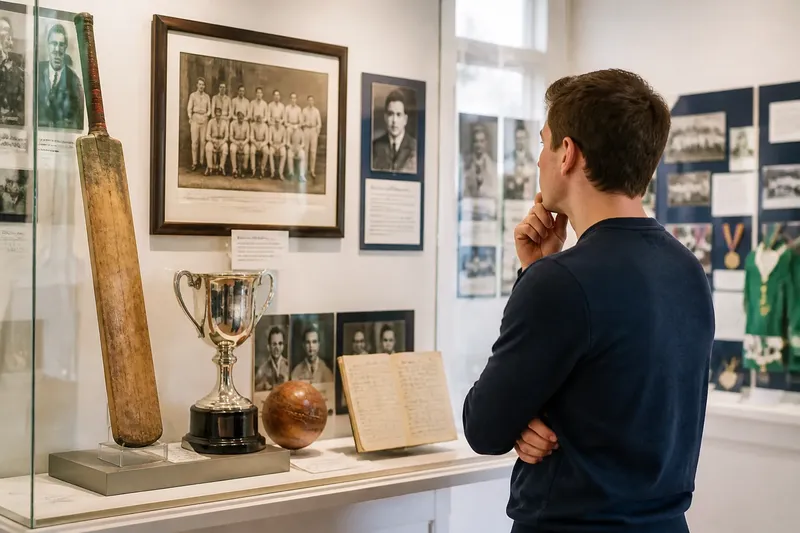
Choose one object that catches your attention before you know much about it. A scuffed cricket bat may be easier to read than a polished trophy: its marks invite questions about use, while the trophy’s inscription may point toward a particular match or award. Look closely at the material, the condition, and the way the object is displayed. Is it behind glass, resting beside a photograph, or isolated on a shelf?
This approach suits visitors who enjoy close observation and do not want to begin with a particular athlete’s biography. It also works well for families: children can pick an object, then look for clues in its caption or nearby images. The aim is not to guess a story from wear alone. A damaged item might have been used hard, repaired, stored poorly, or simply passed through many hands; the label may clarify what the display can actually support.
Look for an object’s route into the hall as well as its sporting use. A caption might name a donor, a club, or a family, revealing that public memory depends on people who preserve and share things. If no source is named, treat that absence as a question rather than a flaw. You may be seeing an artifact whose history has been documented only in part.
Trace an achievement
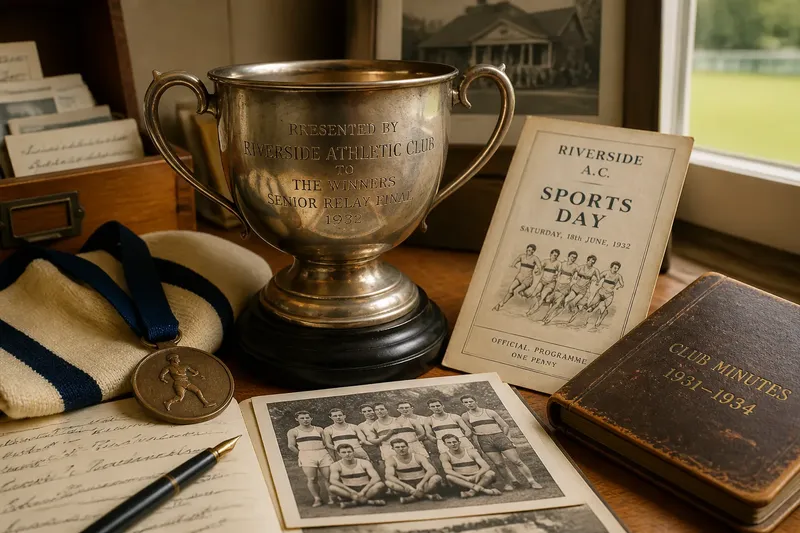
Another option is to begin with a name or accomplishment and follow the display’s account of it. A championship cup may be accompanied by a team photograph, a newspaper clipping, and a short biography. Read those elements together. The cup records recognition; the photograph places the achievement among teammates; the clipping may preserve the language used to describe it at the time. Different formats carry different kinds of evidence.
This approach suits visitors who arrive with a local name in mind, or who want a clear narrative to follow. Check whether the labels distinguish an individual honor from a team result, and whether they explain the setting: the club, school, district, or competition involved. A bare title can tell you what was won without showing why it mattered locally. When a caption includes a venue or opponent, use that detail to understand the achievement’s scale rather than assuming the display explains it all.
Notice how much space the story gives to preparation, setbacks, and people around the athlete. A short label may focus on a decisive result because a small display has limited room; that does not mean the wider account was simple. Equally, do not fill gaps with assumptions about a champion’s feelings or motives. The most careful reading separates what the label says from what a visitor might infer.
Read the absences
A third approach is to compare what receives attention with what appears only briefly—or not at all. Look across names, sports, eras, and forms of participation. Are there several objects from one club but few from another? Do captions foreground winners while showing little about officials, coaches, volunteers, or supporters? Does a team appear in a photograph without its members being named?
This approach suits returning residents, local sports followers, and anyone interested in how a community defines achievement. It is not a demand that every display cover every person or discipline. A hall may have limited space, incomplete records, or a collection shaped by what families and clubs chose to donate. Still, noticing patterns can show which stories have been easiest to preserve and which may need more context.
Absence is a prompt, not proof. A missing name does not establish that someone was excluded, and a small number of artifacts does not reveal why they are scarce. Ask what evidence the display offers, then consider what further source might answer the question: a club archive, a local library collection, or a conversation with a knowledgeable community member. If the hall welcomes questions, you can ask how objects are selected and whether it accepts additional information.
Questions for a first visit?
What should I look at first?
Begin with an object that draws your eye, then read its label before building a story around it. If the object has no caption, look for nearby photographs or names that may provide context.
Should I follow one athlete or one sport?
Follow one athlete when you want a compact story, and one sport when you want to compare how different people and clubs appear. Either route can reveal connections that a quick pass through the room would miss.
How do I read a short caption?
Separate its concrete details—such as a name, club, event, or date—from any interpretation it offers. A concise label is a starting point, not necessarily a full account of the achievement.
What if a story seems incomplete?
Note the question without treating the gap as an answer. A staff member, club record, or local archive may provide context, though the available material may remain partial.
A short visit
Say you have only a brief visit and spot a team photograph beside a silver cup. You read the cup’s inscription, find the same club name beneath the photograph, and notice that only some players are identified. Rather than guessing who is missing, you follow the named players to a nearby caption and ask whether the hall has a fuller team record. You leave with a specific question and a better sense of how the display connects an award to the people around it.
That kind of focused route also helps if you are visiting with someone whose interests differ from yours. One person can follow the object; another can trace the team or compare the labels. Share what each of you noticed at the end. The contrast between a physical clue and a written account often opens a more useful conversation than trying to cover every case.
What to leave aside
It is not worth trying to memorize every name or photograph the entire room in order. A hurried sweep can make a local collection feel like a list, while a small number of closely read objects can show how sport connects to a school, workplace, neighborhood, or club. Avoid treating display order as a ranking unless the hall explicitly says it is one.
Photographs may also be restricted, and objects behind glass are there to be preserved, not handled. Follow posted guidance and ask before taking pictures or recording information. Where an identification or date is unclear, keep your notes tentative rather than repeating a guess as fact.
Carry one question
Before leaving, choose one question the display has raised: who donated a particular object, why one team is represented in detail, or where a missing record might be kept. A local hall of fame visit does not need to produce a complete account of sporting history. Its lasting value may be the more precise understanding that an achievement belongs not only to the person named on a plaque, but also to the community that kept the evidence, chose what to display, and continues to decide what deserves remembering.